Security beyond smart contracts
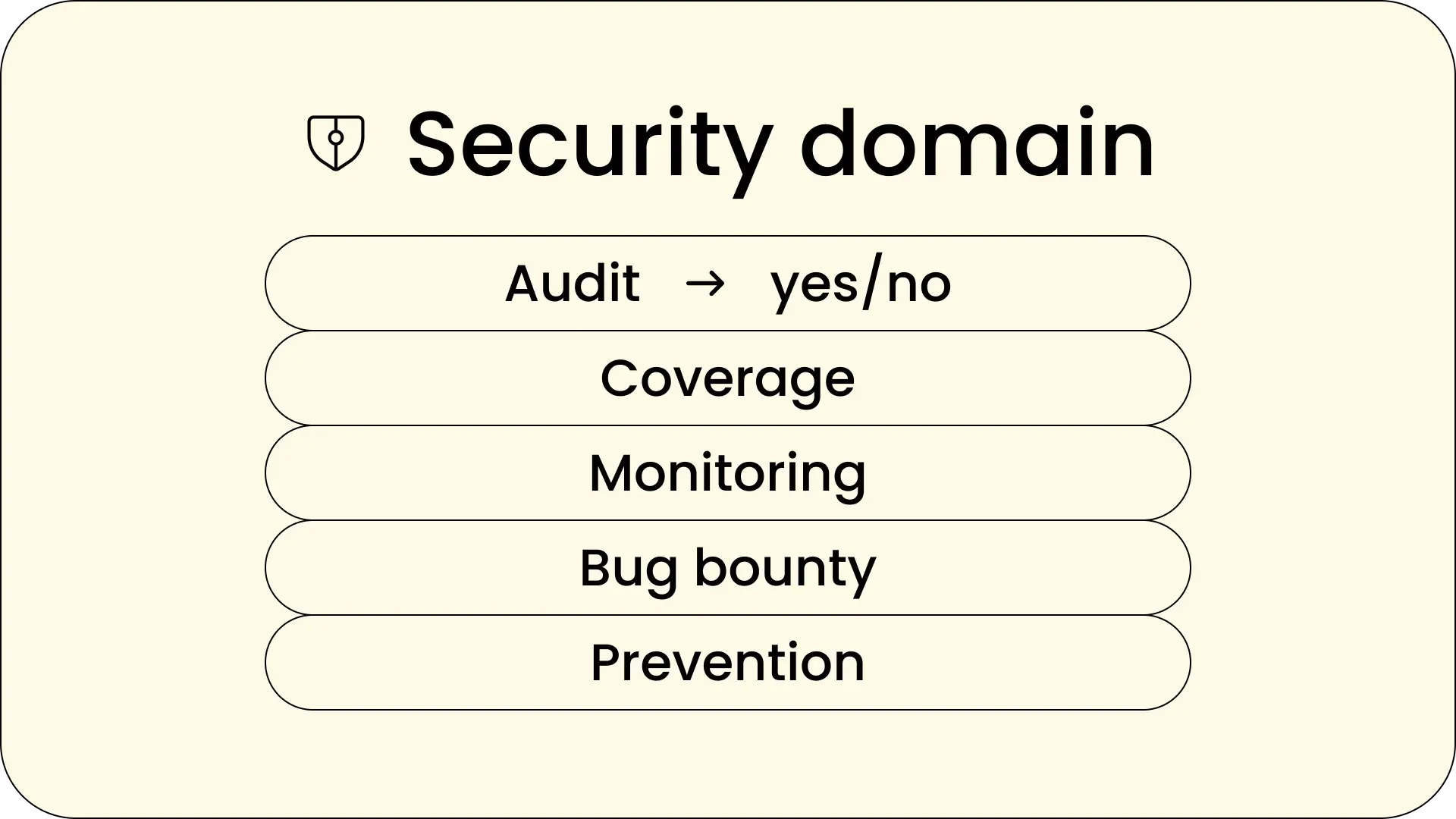
Let's look at how crypto risk management works in the security domain. People always ask if a project has an audit, but that question alone is useless. Euler had ten of them and still got hacked. CORE3 methodology tracks if an audit is present, what it covers, and whether the findings were fixed.
Other metrics answer questions like: Is there a bug bounty program for spotting continuous code vulnerabilities? Will any on-chain monitoring spot the attack in real time?
Beanstalk is one example of why this layered approach is necessary.
In April 2022, someone flash-borrowed over $1B, captured 70% of the voting power, and submitted a malicious proposal with an emergency commit function. The feature wasn’t spotted by auditors because it was outside their coverage.
The other safety measures that could have prevented the attack at some point were missing, too: no bounty, no monitoring, no protection included against a known attack type. This resulted in $182 million vanishing. The protocol died.
Our conclusion reflects the methodology: if you don’t have one of those, the protocol probably will survive thanks to other safety measures. But with all security practices absent, the probability of being a hacker’s target rises exponentially.
The financial metrics that flash before failure

Surprisingly, in crypto, which is a financial sector, financial health metrics work pretty well to signal risk. We assess treasury quality, income sources, revenue dependencies, liquidity concentration, and related factors to predict how well tokenomics will perform under stress.
Terra is still worth revisiting in our case study. Here’s the situation:
Anchor Protocol paid 20% on UST, costing $6 million a day from a shrinking reserve. 75% of all UST was locked in one protocol. The peg was backed with Bitcoin bought during a bull run, correlated to the exact conditions that would trigger a depeg. And the stabilization mechanism contained an unlimited LUNA mint trigger. Once that was activated, the death spiral was arithmetic.
Each of those maps to a PoL sub-metric: revenue sustainability, TVL concentration, treasury quality, and inflation triggers. We could see four signals months before, but industry didn’t connect them to risk. Consequently, $45 billion was erased.
Another case to demonstrate why measuring finance is important from a different angle.
Celsius has advertised 18% yields. The crazy number was funded by using customer deposits in illiquid DeFi strategies. The other issue was the treasury: it consisted of stETH, and they couldn’t redeem it when the bank run started.
Therefore, the financial domain provides an assessment of whether a project's economic structure contains the conditions that historically precede collapse and whether those conditions are quantifiable at present.
Operations opacity to observe

Operations measures: Wash trading, certificates ISO 27001 / CCSS, Founders' track record, Documentation, Liquidity, an other.
A case:
BitConnect reached the top 10 by market cap, even though its GitHub was dead. The project also advertised a trading bot with no documentation. The team was pseudonymous, and on-chain data showed they were okay with wash trading on their platform. On a regular sunny day, BitConnect's price collapsed from $430 to under a dollar in 24 hours.
Another case:
The Squid Game token was smaller ($3.38M), but the execution was lazier. Zero GitHub commits after launch. In a white paper, they claimed to have a Netflix IP tie-in, yet no legal documents confirmed it. Their smart contract had disabled the sell function, which was readable, but didn’t stop the investors from believing. You probably already know the result: the holders became victims of a true Squid Game, left with nothing except worthless tokens after the liquidity was withdrawn.
In retrospect, all these indicators look obvious. But in reality, emotions force people to believe it’s just FUD. That’s why CORE’3 operational domain is designed to make them obvious before the rug.
How can reputation ruin the revenue?
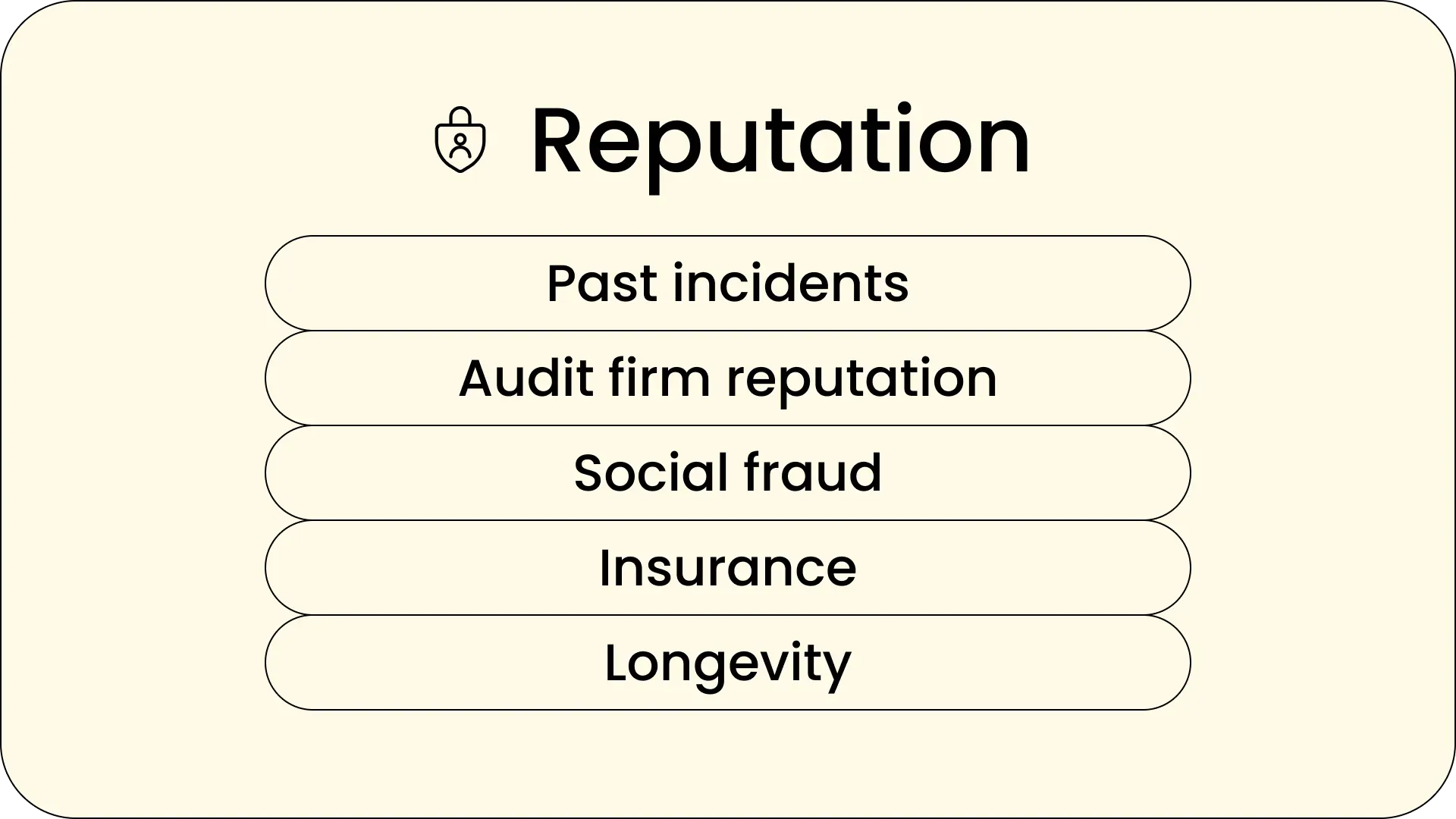
Reputational risk is where past behavior becomes a forward-looking metric. It assesses how a project responds to incidents, social fraud signs, the auditor's reputation, and insurance.
In January 2022, Multichain suffered a $3 million exploit due to a centralized MPC architecture where one person, the CEO, held sole control over all signing keys. Once this became public, no remediation followed. Eighteen months later, $126 million was drained (the project's CEO was arrested 6 weeks before). Cointelegraph later revealed he had allegedly used a fake identity to register the company. On the other hand, official channels continued to reassure users that operations were normal. By shutdown, $1.5 billion in TVL was inaccessible.
If we have seen the compromise before with no remediation followed, it will probably happen again.
Cream Finance makes it even cleaner: three flash-loan hacks in one year ($37M, $29M, $130M), all the same attack class, yet no verified fix followed them. TVL collapsed from over $1 billion to zero. Prior audits by PeckShield and CertiK didn't prevent recurrence. Three hacks of the same type in ten months, with no public post-mortem between them, is why past incident response is a standalone metric in PoL.
Cosmetic compliance checked

Compliance risk measures whether a project operates within established legal frameworks or is structured to avoid them. Projects that choose jurisdictions and disclosure practices to minimize oversight consistently show higher rates of fraud and customer loss.
For example, Tornado Cash, which processed over $7 billion, mixed $455 million stolen by North Korea's Lazarus Group from the Ronin hack. In August 2022, OFAC designated the protocol for this. As a result, the developer was arrested, and the co-founders were indicted by the DOJ on charges of money laundering and sanctions violations.
If assessed by CORE3's current methodology, the compliance signals would be flagged before the designation: no registered entity, no MSB registration despite FinCEN guidance, and the one compliance measure of a front-end block on OFAC-listed wallets (which was pretty cosmetic). OFAC lifted the sanctions on the smart contract in March 2025 following a Fifth Circuit ruling, while the criminal charges remain active.
But we're not to judge; CORE3's goal is to indicate whether the user will incur losses due to legal restrictions.